How does a reverse mortgage work, and is it right for me?

The short answer
A reverse mortgage lets homeowners 62 and older turn part of their home equity into cash, monthly income, or a growing line of credit, with no required monthly mortgage payment, while they keep living in and owning the home. You still pay property taxes, insurance, and upkeep. The Mortgage Advisory arranges FHA-insured HECMs, jumbo (proprietary) reverse mortgages, and reverse mortgage seconds in California, Texas, Florida, and Colorado.
How does a reverse mortgage work, in simple terms?
It's a loan against your home's equity where you don't make a monthly mortgage payment. Instead, the interest and fees are added to the balance over time. You keep the title and keep living in the home. The loan is repaid when the last borrower moves out, sells, or passes away, usually by selling the home, and any equity left over belongs to you or your heirs.
What you do still pay: property taxes, homeowners insurance, HOA dues if you have them, and basic upkeep. That's the deal, and it's how you keep the loan in good standing.
What do other countries call it?
 South Korea
Jutaek Yeongeum
"Home Pension," a government-backed program, age 55+
 Switzerland
Immobilienrente
"Real estate pension," also called a reverse mortgage
 Sweden
Hypotekspension
A leading provider's name: "Swedish Mortgage Pension"
 United States
HECM
A federally insured loan, or "reverse mortgage"
Same idea, different name. In the U.S., it's a loan, and we'll show you exactly how it works.
Who is a reverse mortgage a good fit for?
- Homeowners 62 or older (some proprietary programs start younger, depending on state and program) with solid equity.
- People who want to eliminate a mortgage payment and free up monthly cash flow.
- Retirees who want a safety net: a growing line of credit for health care, home repairs, or a market downturn.
- People who want to age in place instead of selling and moving.
It's usually not the right fit if you plan to move in the next few years, or if paying taxes and insurance would still be a stretch. See alternatives to a reverse mortgage.
What are my options?
| FHA-insured HECM | Jumbo (proprietary) reverse | Reverse mortgage second (HomeSafe Second) | |
|---|---|---|---|
| Who backs it | FHA insurance | Private lender | Private lender |
| Best for | Most homes up to FHA's national limit | Higher-value homes above FHA's limit | Keeping your current first mortgage |
| Your first mortgage | Paid off at closing | Paid off at closing | Stays in place |
| Minimum age | 62 | 62, or 55 in some states | 55 (62 in Texas) |
| Rate | Fixed or adjustable | Varies by program | Fixed |
| Counseling | Required (HUD-approved counselor) | Varies by program | Independent counselor |
Jumbo reverse mortgages and reverse mortgage seconds are not FHA-insured HECMs. Terms, ages, and availability vary by program and state.
How can I take the money?
With a HECM, you can mix and match:
- Line of credit that you draw from when you need it (the unused part grows over time). See how the line of credit grows.
- Monthly payments for life while you live in the home, or for a set number of years. See monthly income for life.
- Lump sum at closing (fixed-rate option).
- HECM for Purchase: use a reverse mortgage to buy your next home, often a right-sized one, with no monthly mortgage payment afterward.
What does a HECM cost?
I believe in showing every cost upfront. On an FHA-insured HECM, the main pieces are set by HUD:
- Upfront FHA mortgage insurance: 2% of the home's value (up to FHA's national limit).
- Annual FHA mortgage insurance: 0.5% of the loan balance, added to the balance over time.
- Origination fee: capped by HUD at the greater of $2,500 or 2% of the first $200,000 of home value plus 1% of the amount over $200,000, and never more than $6,000.
- Standard closing costs: appraisal, title, escrow, recording, and the counseling session.
Most of these can be paid from the loan itself rather than out of pocket. Jumbo reverse mortgages and reverse seconds don't carry FHA insurance, so their cost structure is different; I'll lay it out side by side.
What protects me and my family?
- You can't be forced out as long as you live there as your main home and keep up with taxes, insurance, and upkeep.
- Non-recourse (HECM): neither you nor your heirs will ever owe more than the home is worth.
- Heirs have options: keep the home by paying off the loan (on a HECM, for the lesser of the balance or 95% of appraised value), sell it and keep any equity, or hand the keys over.
- Eligible non-borrowing spouses can have protections to stay in the home under HECM rules.
- Independent counseling: before a HECM, you meet with a HUD-approved counselor who doesn't work for us.
Example scenario (illustrative)
A 72-year-old widow in Tampa owns a $450,000 home and still owes $90,000, with a $1,100 monthly payment squeezing her budget. A HECM pays off the $90,000, ends that monthly mortgage payment, and sets up a line of credit for home repairs and emergencies. She keeps paying her taxes and insurance, keeps her home, and her monthly budget finally breathes.
Our take
In a lot of the world, a reverse mortgage is seen as a housing pension: you spent decades building equity, and now it works for you. It isn't free money, and it isn't for everyone. I'll show you every cost, run the numbers against selling or a HELOC, and encourage you to bring your kids or a trusted advisor to the conversation.
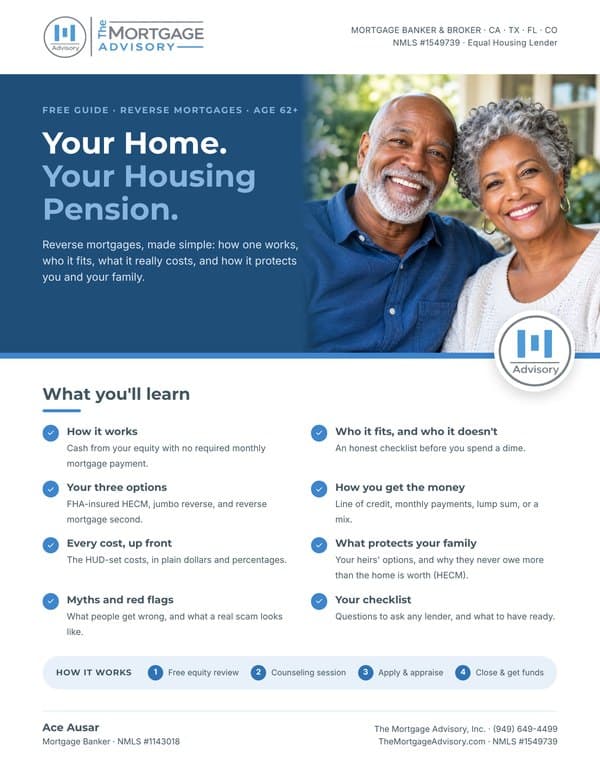
Get your FREE reverse mortgage guide.
Learn how a reverse mortgage works and see if it could be right for you.
Who funds your loan?
We arrange this loan through approved partner lenders and act as your mortgage broker. The partner lender funds the loan. We'll tell you upfront who your lender is and exactly how we're paid; it's all on your Loan Estimate.
Questions people ask
- What are the alternatives to a reverse mortgage?
- Is a reverse mortgage a scam?
- Can you lose your home with a reverse mortgage?
- Can I get a reverse mortgage without paying off my current low-rate mortgage?
- HomeSafe Second (reverse mortgage second) vs. HELOC: which is better if I'm 55 or older?
- How does a reverse mortgage line of credit grow, and how can I use it?
- Who qualifies for a reverse mortgage, and how much equity do I need?
- When is a reverse mortgage a bad idea?
Sources

Ace Ausar, Mortgage Banker · NMLS #1143018
The Mortgage Advisory, Inc. · NMLS #1549739
Reviewed by Ace Ausar, NMLS #1143018 · Updated
Want to see your numbers?
Ask the AI assistant, or book a reverse mortgage call with an advisor. No pressure, made simple.